Eclipse Reads: Book of the Month
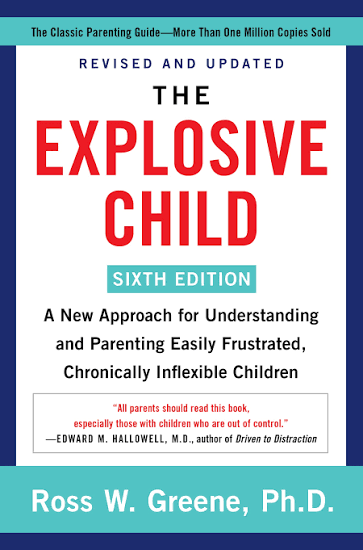
The Explosive Child by Ross. W Greene
Written by Karin Lawless
We’ve all been told how wonderful and fulfilling raising children can be. However, for some parents and caregivers, raising children comes with unexpected challenges; defiance, tantrums, behavioural concerns, anxiety, and more. In a world where there is a lot of pressure on parents to be perfect, these challenges can feel overwhelming and impossible to deal with. As a psychologist who works with children and their caregivers, I hear about these concerns frequently.
My first recommendation is to suggest Ross W. Greene’s book, The Explosive Child. While the title might leave you thinking about a specific type of child, the model Greene introduces can be used with a variety of challenges children and teens experience, even the less explosive ones. Mainly it suggests how parents and caregivers can work with their children, rather than attempting to control or change their behaviour.
Greene originally published this book in 1998 and there have been multiple editions since, all discussing a similar process. If you’ve ever struggled to find solutions for your children’s behaviour and your relationship with them, than this book might be a good fit.
Why this book resonates
As a psychologist that works with children, I am often in conversation with parents and caregivers, and the main theme I run into is parent’s wanting a behaviour with their child to change. With the best intentions, there is often a message of “please fix my child”. I get it. Parents worry about their children’s futures, how they will fare in school, and their future relationships. However, this mentality often results in getting stuck in the problem and can even make the child themselves the problem. If we focus only on the behavioural concern, we lose the bigger picture of what is happening for that child.
The premise of Greene’s book is that kids do well if they can. Generally speaking, children don’t often make choices just to make life harder for the adults around them. Greene suggests that there is likely a skill development problem, rather than just defiance. In order to change the behaviour, we need to understand the skill deficit. Greene even suggests that labels (ADHD, ASD, OCD, ODD), aren’t the real issue. It’s the specific skills that a child might be missing and might struggle to learn.
Another large part of Greene’s book, is the idea that the adults in the child’s life shouldn’t work in isolation around the problem. Rather the child should be involved in identifying the problem and worked with to find a solution. This is the part I really like about this book. Problem solving becomes collaborative, giving a voice to the children the adults are trying to manage/fix.
The most useful part: Resources, scripts, and a model to follow
Greene walks the reader through specific steps to implement the strategies outlined in the book, using a model he calls Collaborative and Proactive Solutions (CPS) Model. Throughout the book he uses specific examples and case studies of how these strategies work and common pitfalls adults fall into. If reading the book is not available to you, Greene has a website with free videos that walk you through the same principles that are in the book. Check out: https://livesinthebalance.org/tkwaok/
What This Book Does Not Do
While this book has great strategies, it does not sugar coat that a big part of change relies heavily on the parents/caregivers. A large part of this process requires a pretty hefty perspective shift from parents, acknowledging that their own feelings on the matter can interfere with the process. Greene outlines specific steps (Plan A, B, and C), that require the adults to manage their own feelings and even put them aside. While I do believe this is an important skill in child raising, it’s not something easily done. Adults have their own skill deficits at times, and the book doesn’t hold a lot of space for that.
Final Thoughts
I believe The Explosive Child is a good starting point for parents and caregivers who are struggling with behavioural concerns from their children. It’s not the end all be all of strategies, but it gives a framework to think differently about children’s problems. I do believe Greene’s stance might be a hard pill for some parents/caregivers to swallow. It promises a slow process that shifts the perspective of adults in control to collaboratively working with children of all ages. However, I do believe it is a helpful perspective that puts children’s needs and experiences at the front of the conversation. That, I believe, is the right direction to go in.